Monday, January 17, 2022


Pacific volcano: Science will explain event's ferocity
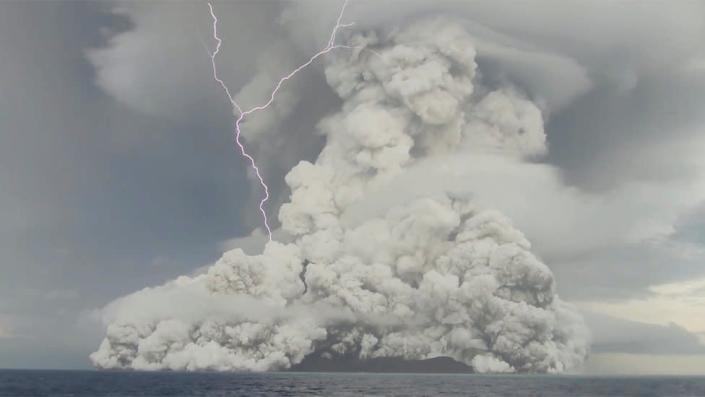
Hunga-Tonga Hunga-Ha'apai

The explosive eruption of Hunga-Tonga Hunga-Ha'apai sent a shockwave around the world.

The event literally touched every corner of the globe as a pressure wave spread out in all directions to complete a full circumnavigation.

Scientists, of course, are now asking themselves why the eruption was so powerful. They also want to understand how the tsunami was created.

The answers to both these questions feed into future hazard preparedness, although to be honest, right now, these finer details are much less important than the immediate needs of nearby islanders.

Their lives have been up-ended by catastrophic flooding and ash fall-out.

Nonetheless, scientific insights will emerge; they're already being assembled.

The name Hunga-Tonga Hunga-Ha'apai (HT-HH) refers to the two island structures that stood about 100m above the Pacific Ocean surface, roughly 65km north of Tonga's capital, Nuku'alofa.

What wasn't apparent to the casual observer was the hidden edifice below-water - a volcanic mountain rising some 1,800m above the seafloor.

The HT-HH islands represented just the upper-most part of the rim of a caldera - the opening to the volcano - that was 6km across. It was in this submerged caldera that gas-rich magma came into contact with cold seawater to devastating effect.

For Prof Shane Cronin, from the University of Auckland, who's made a detailed study of this volcano, the water depth was critical.

"The caldera summit is about 150-200m below sea-level. That's just about the right depth for there to be quite strong, explosive interactions between the magma and the seawater," he told BBC News.

"Once you get much, much deeper, then what tends to happen is there's too much seawater, and it suppresses that explosive activity."

Prof Cronin said a big event had been due. The last major eruption was in the year AD 1100, and prior to that there was a major episode 1,800 years ago. On that basis the repeat cycle was roughly 900 years. That's now.


Earth's climate went off the rails in 2021, reports show

Global warming became local to a new and devastating extent in 2021, with the year ranking as the sixth-warmest on record, according to new, independent data from NASA, NOAA and Berkeley Earth.

Why it matters: Each year's data adds to the relentless long-term trend, which shows rapid warming due overwhelmingly to human-caused greenhouse gas emissions during the past several decades in particular.

Get market news worthy of your time with Axios Markets. Subscribe for free.

  • The global shifts in ocean heat, atmospheric moisture, and surface temperatures on shorter timescales are increasingly being felt in the form of unprecedented and deadly extreme weather and climate events.

The big picture: The three temperature tracking groups matched data released earlier this week by the European Union's Copernicus Climate Change Service, and show how the presence of a La Niña event in the tropical Pacific Ocean, which features cooler than average sea surface temperatures near the equator, failed to dislodge 2021 from the list of top 10 years.

Between the lines: The next year that features an El Niño in the tropical Pacific, which is La Niña's warmer sibling, is almost assured to set a record for the warmest year, since it can further accelerate human-caused warming.

  • Last year featured a relentless series of extreme weather and climate disasters that saw temperatures and water levels reach unprecedented levels.

  • A June heat wave in the Pacific Northwest, for example, set a temperature record for the hottest reading (121°F) ever seen in Canada, along with all-time highs in Oregon and Washington. The town that set the Canadian record, Lytton, British Columbia, burned in a wildfire the next day.

  • A study found the heat wave could not have occurred without human-caused global warming.

  • "Changes in extreme events are global warming writ local," NASA's Gavin Schmidt, who directs the agency's Goddard Institute for Space Studies in New York City, told Axios in an email.

Thursday, March 18, 2021


Test firing of NASA moon rocket sets stage for maiden flight

William Harwood

NASA and Boeing readied a gargantuan Space Launch System rocket for a second test firing in Mississippi Thursday to clear the way for a long-delayed maiden flight late this year or early next to kick off the space agency's Artemis moon program.

Two months after glitches cut short an initial attempt on January 16, the 21-story SLS core stage's four shuttle-heritage RS-25 main engines were expected to ignite one after the other, at 120 millisecond intervals, throttling up to a combined thrust of 1.6 million pounds. The two-hour test window opens at 3 p.m. EDT.

Firmly locked down on a massive test stand at NASA's Stennis Space Center just east of New Orleans, the core stage's Aerojet Rocketdyne engines were expected to fire for up to eight minutes — the duration of an actual climb out of the atmosphere — consuming more than 700,000 gallons of liquid oxygen and hydrogen in the process.

The 212-foot-tall core stage of NASA's Space Launch System rocket, mounted on the B-2 test stand at the agency's Stennis Space Center in Mississippi. Depending on the results of a second test firing Thursday, NASA hopes to ship the stage to Florida in about a month to ready the first SLS for an unpiloted maiden flight. / Credit: NASA
- ADVERTISEMENT -

The test run called for throttling the engines down and back up as they will be during an actual flight, testing the rocket's thrust vector control, or steering, system and monitoring how propellant tank pressures are maintained as the fuel level drops.

Data from hundreds of sensors will reflect a wide variety of parameters, including critical vibration levels at different thrust settings. The data will feed into 10 "detailed verification objectives," or DVOs, required to demonstrate the rocket is ready for flight.

Mission managers said they expected to collect all the data needed in the first four minutes, but planned to let the engines run twice that long to simulate an actual climb to space and to monitor performance when the tanks are nearly empty and the rocket weighs a fraction of its initial 2.3 million pounds.

"This is not by any means a vanilla firing the core stage," said Boeing SLS manager John Shannon. "Since it's a highly instrumented vehicle, we're taking that opportunity to do some very aggressive maneuvers of the thrust vector control system. ... It's going to stress the vehicle.

Sunday, April 26, 2020

News

New York and U.K. Have Fewest Deaths Since March: Virus Update

Bloomberg News
New York and U.K. Have Fewest Deaths Since March: Virus Update
(Bloomberg) --
Spain and Italy reported the smallest rise in coronavirus fatalities in more than a month, while the death tolls in the U.K. and New York were the lowest since the end of March.
Deborah Birx, coordinator of the White House coronavirus task force, said U.S. President Donald Trump understands that disinfectant isn’t a treatment for Covid-19.
France and Saudi Arabia are among nations taking steps toward adjusting their lockdowns, or considering such a move. By contrast, Argentina and Kenya plan to extend limits.
Key Developments
Virus Tracker: Total cases 2.9 million; deaths exceed 203,000EU report says China deflected blame for pandemicWHO casts doubt on immunity after Covid-19 infectionBack-to-work is complicated decision for many workersEurope’s factories are starting up againWhy a second wave of Covid-19 is already a worry
Subscribe to a daily update on the virus from Bloomberg’s Prognosis team here. Click VRUS on the terminal for news and data on the coronavirus. For a look back at this week’s top stories from QuickTake, click here.
N.Y. Deaths Lowest Since March 31 (12:05 p.m. NY)
New York Governor Andrew Cuomo said new deaths fell to 367, the fewest since March 31, and virus cases continues to decline across the state.
Hospitalizations also declined, extending a trend from last week. The state also reported fewer new cases, Cuomo said.
Italy Deaths Slow (12 p.m. NY)
Italy reported its fewest virus fatalities since the early days of its nationwide lockdown as the government plans to gradually restart its economy and allow people limited movement.
Civil defense authorities reported 260 deaths for the 24-hour period -- the fewest since March 14 -- compared with 415 the day before. That brings the total number of fatalities to 26,644. Confirmed cases now total 197,675.
There were 2,324 new cases compared with 2,357 a day earlier.
State Hotlines Called on Disinfectants (11:50 a.m. NY)
New Jersey and Michigan emergency centers were flooded with calls last week after President Trump discussed the use of disinfectants to deal with Covid-19, the states’ governors said.

Friday, March 6, 2020

Trump's mental state — not Biden's — is the real concern, mental health professionals say

David Knowles
Editor


Trump's declining faculties — not Biden's — is the real concern, mental health professionals say
Scroll back up to restore default view.
Mental health professionals who have expressed concern over what they see as Donald Trump’s declining faculties say that similar fears about Joe Biden’s are overblown.
“A few stumbled words are not the same as the extreme danger that result from a list of signs that Donald Trump has shown,” Bandy Lee, a psychiatrist on the faculty at the Yale School of Medicine, told Yahoo News, “and none of them apply to Joe Biden.”
Lee edited a collection of essays written by 27 mental health professionals titled “The Dangerous Case of Donald Trump,” which detailed what the authors see as the risks posed by a leader who they regard as mentally and emotionally unfit for the most powerful office in the world.
Yet since Biden’s reemergence as a front-runner for the Democratic presidential nomination, Lee has been flooded by requests to assess the former vice president’s string of stumbles in public appearances. In response, she published a piece on Medium correcting what she sees as the false equivalence between Trump’s “mental instability” and Biden’s occasional gaffes.
Trump frequently misstates or invents statistics or facts in his speeches, and in remarks last year seemed confused on the birthplace of his own father, saying he was born in Germany. (It was the Bronx.) Biden bungled an appeal for campaign volunteers at a debate last year, and recently shared what appeared to be a false memory of being “arrested on the streets of Soweto,” in South Africa, on his way to visit Nelson Mandela. (He was briefly detained at an airport during an official visit, but not arrested.)
Joe Biden and Donald Trump. (Photo illustration: Yahoo News; photos: AP (2), Getty Images (2))
“None of them are catastrophically alarming the way the signs have been with Donald Trump. I think there needs to be a measure of proportion here. On the one hand, we have such mental instability and such great cognitive decline as well as neurological signs that show imminent risk to the entire human civilization, compared with some gaffes perhaps. If we’re not addressing the former, why are we even talking about the latter?”
Oat milk was the most sought-after product in February in the food and beverage category that Nielsen tracks The surge in demand could be because it has a longer shelf-life than cow’s milk, which may appeal to consumers who want to be ready to shelter in place or engage in “social distancing,” which CDC officials have said could help stop the spread of the coronavirus
“As consumers assess their purchasing decisions around what can be stored for long periods and what cannot, there’s little doubt that buying will shift toward shelf-stable and frozen options,” Nielsen wrote in a report about “Pandemic Pantries” (The World Health Organization has declared the coronavirus a “global health emergency,” the organization’s highest alert level, but it is not considered a pandemic.)
Oatly, a brand of oat milk sold in the US., says that the 32 oz cartons sold on its site are “shelf-stable and will stay fresh until the best by date.” Until the carton is opened, there is no need to refrigerate it, Oatly adds.
Sales of aerosol disinfectant products were nearly 100% higher than last year, Nielsen found Sales of bath and shower wipes had increased nearly 60%. Several companies — including Clorox, GOJO (Purell’s parent company) and Lysol — claim to cleanse surfaces of coronavirus, but haven’t actually tested it against the novel coronavirus COVID19
American consumers are cutting back on fresh fruit and vegetables — sales for apples and celery decreased by 4% and 16% respectively in the last week of February, according to Nielsen But dried beans increased by 36.9%. (Beans are a favored staple of some “survivalists.”)
Shoppers have been flocking to stores like Costco US:COST to stock up on these products. The company reported better than expected results for the second quarter. Analysts attributed this to “an uptick in consumer demand.”