Monday, January 17, 2022


Pacific volcano: Science will explain event's ferocity
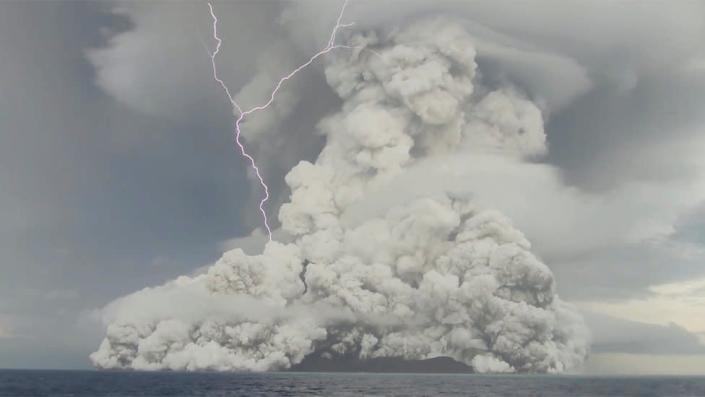
Hunga-Tonga Hunga-Ha'apai

The explosive eruption of Hunga-Tonga Hunga-Ha'apai sent a shockwave around the world.

The event literally touched every corner of the globe as a pressure wave spread out in all directions to complete a full circumnavigation.

Scientists, of course, are now asking themselves why the eruption was so powerful. They also want to understand how the tsunami was created.

The answers to both these questions feed into future hazard preparedness, although to be honest, right now, these finer details are much less important than the immediate needs of nearby islanders.

Their lives have been up-ended by catastrophic flooding and ash fall-out.

Nonetheless, scientific insights will emerge; they're already being assembled.

The name Hunga-Tonga Hunga-Ha'apai (HT-HH) refers to the two island structures that stood about 100m above the Pacific Ocean surface, roughly 65km north of Tonga's capital, Nuku'alofa.

What wasn't apparent to the casual observer was the hidden edifice below-water - a volcanic mountain rising some 1,800m above the seafloor.

The HT-HH islands represented just the upper-most part of the rim of a caldera - the opening to the volcano - that was 6km across. It was in this submerged caldera that gas-rich magma came into contact with cold seawater to devastating effect.

For Prof Shane Cronin, from the University of Auckland, who's made a detailed study of this volcano, the water depth was critical.

"The caldera summit is about 150-200m below sea-level. That's just about the right depth for there to be quite strong, explosive interactions between the magma and the seawater," he told BBC News.

"Once you get much, much deeper, then what tends to happen is there's too much seawater, and it suppresses that explosive activity."

Prof Cronin said a big event had been due. The last major eruption was in the year AD 1100, and prior to that there was a major episode 1,800 years ago. On that basis the repeat cycle was roughly 900 years. That's now.


Earth's climate went off the rails in 2021, reports show

Global warming became local to a new and devastating extent in 2021, with the year ranking as the sixth-warmest on record, according to new, independent data from NASA, NOAA and Berkeley Earth.

Why it matters: Each year's data adds to the relentless long-term trend, which shows rapid warming due overwhelmingly to human-caused greenhouse gas emissions during the past several decades in particular.

Get market news worthy of your time with Axios Markets. Subscribe for free.

  • The global shifts in ocean heat, atmospheric moisture, and surface temperatures on shorter timescales are increasingly being felt in the form of unprecedented and deadly extreme weather and climate events.

The big picture: The three temperature tracking groups matched data released earlier this week by the European Union's Copernicus Climate Change Service, and show how the presence of a La Niña event in the tropical Pacific Ocean, which features cooler than average sea surface temperatures near the equator, failed to dislodge 2021 from the list of top 10 years.

Between the lines: The next year that features an El Niño in the tropical Pacific, which is La Niña's warmer sibling, is almost assured to set a record for the warmest year, since it can further accelerate human-caused warming.

  • Last year featured a relentless series of extreme weather and climate disasters that saw temperatures and water levels reach unprecedented levels.

  • A June heat wave in the Pacific Northwest, for example, set a temperature record for the hottest reading (121°F) ever seen in Canada, along with all-time highs in Oregon and Washington. The town that set the Canadian record, Lytton, British Columbia, burned in a wildfire the next day.

  • A study found the heat wave could not have occurred without human-caused global warming.

  • "Changes in extreme events are global warming writ local," NASA's Gavin Schmidt, who directs the agency's Goddard Institute for Space Studies in New York City, told Axios in an email.