Pacific volcano: Science will explain event's ferocity
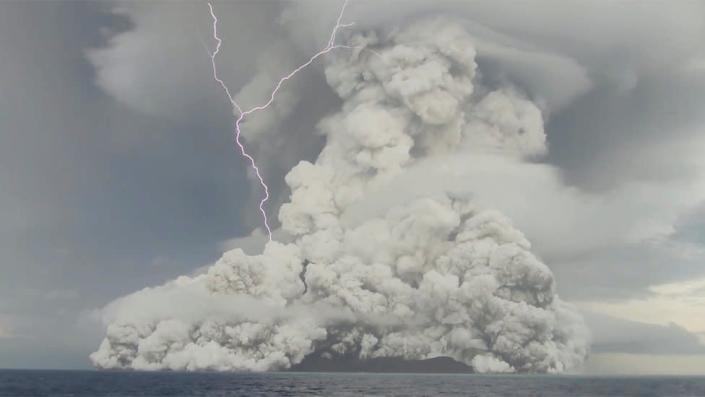
The explosive eruption of Hunga-Tonga Hunga-Ha'apai sent a shockwave around the world.
The event literally touched every corner of the globe as a pressure wave spread out in all directions to complete a full circumnavigation.
Scientists, of course, are now asking themselves why the eruption was so powerful. They also want to understand how the tsunami was created.
The answers to both these questions feed into future hazard preparedness, although to be honest, right now, these finer details are much less important than the immediate needs of nearby islanders.
Their lives have been up-ended by catastrophic flooding and ash fall-out.
Nonetheless, scientific insights will emerge; they're already being assembled.
The name Hunga-Tonga Hunga-Ha'apai (HT-HH) refers to the two island structures that stood about 100m above the Pacific Ocean surface, roughly 65km north of Tonga's capital, Nuku'alofa.
What wasn't apparent to the casual observer was the hidden edifice below-water - a volcanic mountain rising some 1,800m above the seafloor.
The HT-HH islands represented just the upper-most part of the rim of a caldera - the opening to the volcano - that was 6km across. It was in this submerged caldera that gas-rich magma came into contact with cold seawater to devastating effect.
For Prof Shane Cronin, from the University of Auckland, who's made a detailed study of this volcano, the water depth was critical.
"The caldera summit is about 150-200m below sea-level. That's just about the right depth for there to be quite strong, explosive interactions between the magma and the seawater," he told BBC News.
"Once you get much, much deeper, then what tends to happen is there's too much seawater, and it suppresses that explosive activity."
Prof Cronin said a big event had been due. The last major eruption was in the year AD 1100, and prior to that there was a major episode 1,800 years ago. On that basis the repeat cycle was roughly 900 years. That's now.

No comments:
Post a Comment