Tuesday, February 28, 2023


Drone crash near Moscow was failed attack, governor says
  • Published
Related Topics
DroneIMAGE SOURCE,ANTON GERASHCHENKO
Image caption,
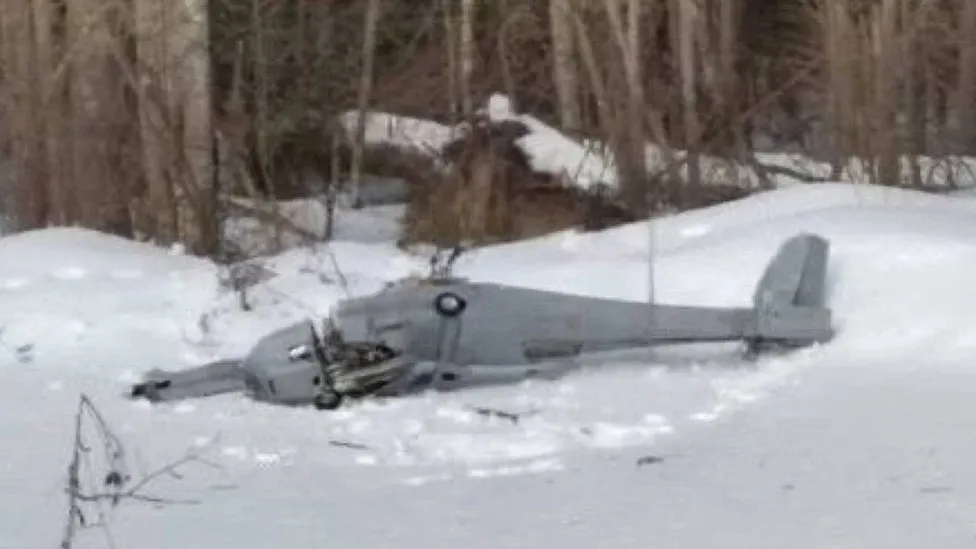
A picture appears to show a Ukrainian manufactured UJ-22 drone

A drone has crashed in the Moscow region in what was likely an attempt to target civilian infrastructure, the regional governor said.

Andrei Vorobyov was speaking after the defence ministry reported downing two Ukrainian drones in southern Russia.

Ukraine does not claim responsibility for attacks inside Russia.

Russian energy giant Gazprom operates a facility near the village of Gubastovo, about 100 km (62 miles) from Moscow, where the drone crashed.

Gazprom told Russian state-run news agency RIA Novosti that its operations in the Kolomna district had not been interrupted.

The target of the drone in Kolomna "was probably a civilian infrastructure facility, which was not damaged", Mr Vorobyov posted on Telegram.

"There are no casualties or damage on the ground. The FSB (Russian security service) and other competent authorities are investigating," he added.

Images shared by Russian media and officials show a damaged drone in a snow-covered field in front of a forest of birch trees. The area around the Gazprom facility is heavily forested.

The appearance of the drone matches that of the UJ-22 Airborne, a product of Ukrainian manufacturer Ukrjet.

Ukrjet says the vehicle has a range of 800km - enough for it to reach the Kolomna area from Ukraine.

A reverse image reveals no previous matches for the image, suggesting it is recent.

Anton Gerashchenko, advisor to Ukraine's minister of internal affairs, tweeted a photo of the drone.

"It is more than 500km away from Russian border with Ukraine. Soon Putin might get very afraid to show himself in public as drones can reach far distances," he wrote alongside the photo.

If Ukraine was behind the Kolomna drone, it would be the closest attempted drone attack to the capital since Russia invaded Ukraine more than a year ago.

It came as the Russian defence ministry said its forces had downed two Ukrainian drones in southern Russia.

The ministry accused Kyiv of attempting to use drones "to attack civilian infrastructure in the Krasnodar region and the Adygea Republic", adding that they were "neutralised by electronic warfare units".

Moscow has accused Ukraine of being behind attacks on Russian military infrastructure during the war, but Kyiv has not confirmed this.

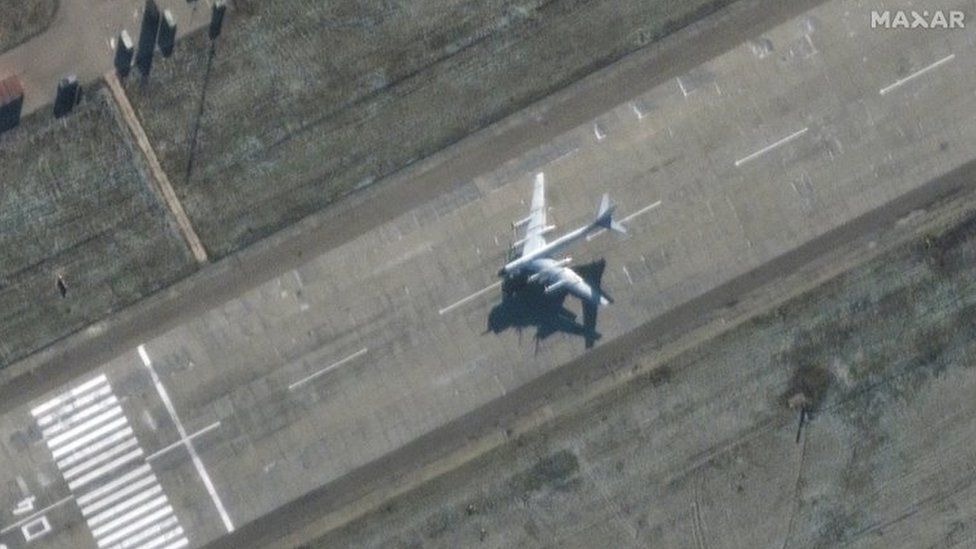
A Ukrainian drone attack on an airbase for bombers in southern Russia in December left three people dead, Moscow said. The Ukrainian military did not officially admit to the attack, but air force spokesman Yuriy Ihnat said the explosions were the result of what Russia was doing on Ukrainian soil.

Just weeks before, Russia accused Ukraine of a similar attack on the same airfield, which is home to bombers that have carried out missile attacks on Ukraine.

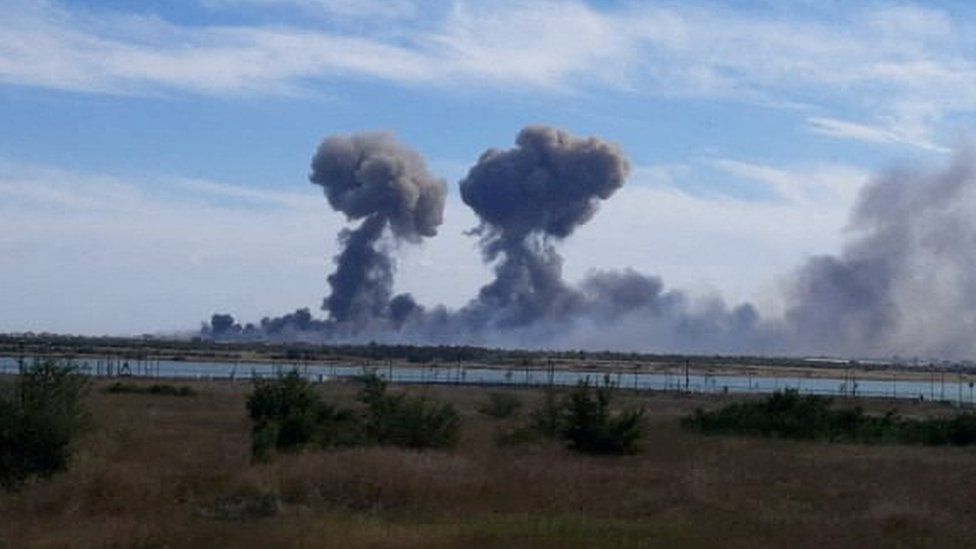
In August, a series of blasts rocked a military base in Crimea, in what was seen as a significant expansion of the conflict by Ukraine into Crimea, which was annexed by Russia in 2014. Ukraine later claimed responsibility for that attack.

President Vladimir Putin told the FSB on Tuesday to intensify its activity against what he said was increasing espionage and sabotage by Ukraine and the West.

He instructed the FSB to strengthen security in territories occupied by Russia in eastern Ukraine. He said units deployed at the border must stop sabotage groups and prevent the passage of illegal weapons and ammunition.

"We need to beef up our counterintelligence in general, because Western special services have traditionally been very active in relation to Russia," he said.

"And now they have put in additional personnel, technical and other resources against us. We need to respond accordingly."

Russia's defence ministry said its fighter jets were involved in a training exercise in the country's western airspace on Tuesday, hours after airspace over St Petersburg was closed due to reports of an unidentified object.

(Additional reporting by Adam Robinson)
Sunday, January 1, 2023


Russia launches major New Year’s Eve missile strike against Ukraine

In this article:
  • Vitali Klitschko
    Vitali Klitschko
    Ukrainian boxer and politician (1971-)
A damaged hotel at the scene of Russian shelling in Kyiv, Ukraine, Saturday, Dec. 31, 2022. (AP Photo/Efrem Lukatsky)
A damaged hotel at the scene of Russian shelling in Kyiv, Ukraine. (AP/Efrem Lukatsky)

KYIV — Ukrainians preparing to celebrate the New Year as best they could were hit by another wave of Russian missile attacks on Saturday. The majority of targets struck appeared to be civilian structures, including a now-uninhabitable hotel. The attack wounded at least 28 across the country, and killed one, Kyiv Mayor Vitali Klitschko said.

According to Valerii Zaluzhnyi, Ukraine’s commander in chief, 20 cruise missiles were fired from ground-based launchers and Russian Tu-95MS “Bear” strategic bombers flying above the Caspian Sea. Twelve of the missiles were shot down by Ukrainian air defenses; six alone above the skies of Kyiv, Zaluzhnyi said. However, an unknown number struck inside Ukraine. The total is as yet unknown because an “unspecified number” of the munitions malfunctioned and crashed somewhere inside Russia, according to Ukraine’s General Staff.

Yahoo News visited impact sites earlier today in the Ukrainian capital. In one case, a missile scored a near direct hit on the Alfavito Hotel in the central Pecherskiy District; in another, a parking lot in the middle of a civilian housing estate.

Smoke rises after a Russian missile strike, amid Russia's attack on Ukraine, in Kyiv, Ukraine December 31, 2022. REUTERS/Vladyslav Sodel
Smoke rises after a Russian missile strike in Kyiv, Ukraine. (Reuters/Vladyslav Sodel)

Whole sections of the Alfavito building collapsed, and rescue workers combed through the rubble, searching for survivors. Casualties appeared to be light, because the hotel was largely unoccupied. Windows in the nearby National Palace of Arts, a large, Soviet-era concert hall, were blown out in the blast.

The second missile strike site Yahoo News visited was in the Solomianskyi District, in the western part of the city. The bomb struck the center courtyard of a housing project, causing heavy damage to all the buildings in the development. Cars in the parking lot were peppered with shrapnel, and some Ukrainian civilians had already begun the process of patching up their battered homes. Others were packing their bags, as the damage was too severe, or the trauma too great, for a feasible night in their homes.

“My dogs were terrified by the noise, but now they’re fine,” Anna, a Kyiv resident close to the blasts, told Yahoo News. “I’ll still be drinking champagne later.”

Monday, January 17, 2022


Pacific volcano: Science will explain event's ferocity

Hunga-Tonga Hunga-Ha'apai

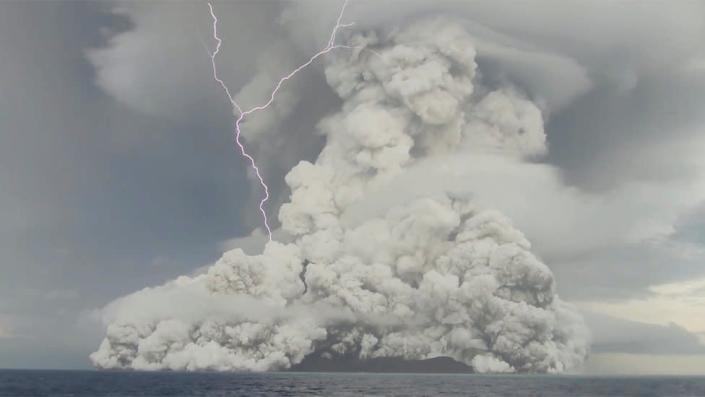
The explosive eruption of Hunga-Tonga Hunga-Ha'apai sent a shockwave around the world.

The event literally touched every corner of the globe as a pressure wave spread out in all directions to complete a full circumnavigation.

Scientists, of course, are now asking themselves why the eruption was so powerful. They also want to understand how the tsunami was created.

The answers to both these questions feed into future hazard preparedness, although to be honest, right now, these finer details are much less important than the immediate needs of nearby islanders.

Their lives have been up-ended by catastrophic flooding and ash fall-out.

Nonetheless, scientific insights will emerge; they're already being assembled.

The name Hunga-Tonga Hunga-Ha'apai (HT-HH) refers to the two island structures that stood about 100m above the Pacific Ocean surface, roughly 65km north of Tonga's capital, Nuku'alofa.

What wasn't apparent to the casual observer was the hidden edifice below-water - a volcanic mountain rising some 1,800m above the seafloor.

The HT-HH islands represented just the upper-most part of the rim of a caldera - the opening to the volcano - that was 6km across. It was in this submerged caldera that gas-rich magma came into contact with cold seawater to devastating effect.

For Prof Shane Cronin, from the University of Auckland, who's made a detailed study of this volcano, the water depth was critical.

"The caldera summit is about 150-200m below sea-level. That's just about the right depth for there to be quite strong, explosive interactions between the magma and the seawater," he told BBC News.

"Once you get much, much deeper, then what tends to happen is there's too much seawater, and it suppresses that explosive activity."

Prof Cronin said a big event had been due. The last major eruption was in the year AD 1100, and prior to that there was a major episode 1,800 years ago. On that basis the repeat cycle was roughly 900 years. That's now.


Earth's climate went off the rails in 2021, reports show

Global warming became local to a new and devastating extent in 2021, with the year ranking as the sixth-warmest on record, according to new, independent data from NASA, NOAA and Berkeley Earth.

Why it matters: Each year's data adds to the relentless long-term trend, which shows rapid warming due overwhelmingly to human-caused greenhouse gas emissions during the past several decades in particular.

Get market news worthy of your time with Axios Markets. Subscribe for free.

  • The global shifts in ocean heat, atmospheric moisture, and surface temperatures on shorter timescales are increasingly being felt in the form of unprecedented and deadly extreme weather and climate events.

The big picture: The three temperature tracking groups matched data released earlier this week by the European Union's Copernicus Climate Change Service, and show how the presence of a La Niña event in the tropical Pacific Ocean, which features cooler than average sea surface temperatures near the equator, failed to dislodge 2021 from the list of top 10 years.

Between the lines: The next year that features an El Niño in the tropical Pacific, which is La Niña's warmer sibling, is almost assured to set a record for the warmest year, since it can further accelerate human-caused warming.

  • Last year featured a relentless series of extreme weather and climate disasters that saw temperatures and water levels reach unprecedented levels.

  • A June heat wave in the Pacific Northwest, for example, set a temperature record for the hottest reading (121°F) ever seen in Canada, along with all-time highs in Oregon and Washington. The town that set the Canadian record, Lytton, British Columbia, burned in a wildfire the next day.

  • A study found the heat wave could not have occurred without human-caused global warming.

  • "Changes in extreme events are global warming writ local," NASA's Gavin Schmidt, who directs the agency's Goddard Institute for Space Studies in New York City, told Axios in an email.

Thursday, March 18, 2021


Test firing of NASA moon rocket sets stage for maiden flight

William Harwood

NASA and Boeing readied a gargantuan Space Launch System rocket for a second test firing in Mississippi Thursday to clear the way for a long-delayed maiden flight late this year or early next to kick off the space agency's Artemis moon program.

Two months after glitches cut short an initial attempt on January 16, the 21-story SLS core stage's four shuttle-heritage RS-25 main engines were expected to ignite one after the other, at 120 millisecond intervals, throttling up to a combined thrust of 1.6 million pounds. The two-hour test window opens at 3 p.m. EDT.

Firmly locked down on a massive test stand at NASA's Stennis Space Center just east of New Orleans, the core stage's Aerojet Rocketdyne engines were expected to fire for up to eight minutes — the duration of an actual climb out of the atmosphere — consuming more than 700,000 gallons of liquid oxygen and hydrogen in the process.

The 212-foot-tall core stage of NASA's Space Launch System rocket, mounted on the B-2 test stand at the agency's Stennis Space Center in Mississippi. Depending on the results of a second test firing Thursday, NASA hopes to ship the stage to Florida in about a month to ready the first SLS for an unpiloted maiden flight. / Credit: NASA
- ADVERTISEMENT -

The test run called for throttling the engines down and back up as they will be during an actual flight, testing the rocket's thrust vector control, or steering, system and monitoring how propellant tank pressures are maintained as the fuel level drops.

Data from hundreds of sensors will reflect a wide variety of parameters, including critical vibration levels at different thrust settings. The data will feed into 10 "detailed verification objectives," or DVOs, required to demonstrate the rocket is ready for flight.

Mission managers said they expected to collect all the data needed in the first four minutes, but planned to let the engines run twice that long to simulate an actual climb to space and to monitor performance when the tanks are nearly empty and the rocket weighs a fraction of its initial 2.3 million pounds.

"This is not by any means a vanilla firing the core stage," said Boeing SLS manager John Shannon. "Since it's a highly instrumented vehicle, we're taking that opportunity to do some very aggressive maneuvers of the thrust vector control system. ... It's going to stress the vehicle.